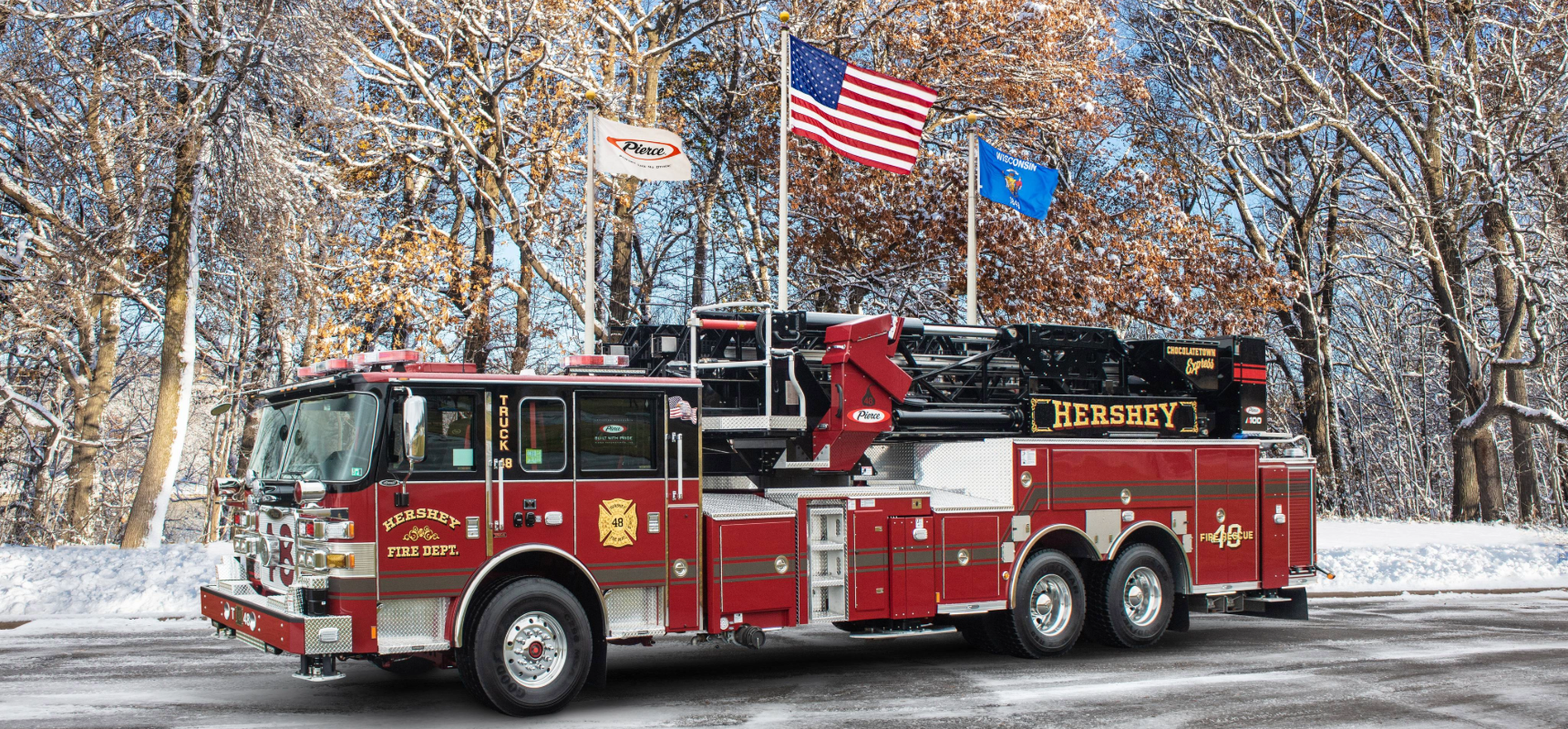
When the Hershey Volunteer Fire Company needed to enhance their frontline capabilities, they turned to Pierce Manufacturing to deliver new apparatus.
For a volunteer department serving a dynamic population with a wide range of incident types, customization, reliability and ease of operation are critical.
In a recent episode of the Pierce™ Dispatch Podcast, Chief Pat Leonard and Assistant Chief Colton Leonard shared more about their department, community needs and the strategy behind their new Pierce fire trucks.
Understanding a Unique Community and its Demands
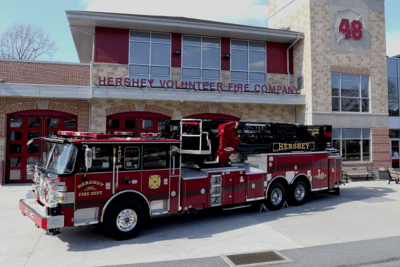 Hershey Volunteer Fire Company (HVFC) is a 100% volunteer company with nearly 30 active members and three 'live-ins' on site each day. HVFC serves a complex and evolving community which blends residential neighborhoods, industrial and commercial zones, major tourism and the operational demands of a regional medical center.
To understand these pressures placed on the department, it's helpful to look at the diverse environments and hazards it protects daily:
- Residential - everything from single-family homes to multi-story apartment buildings.
- Commercial and tourism-driven venues - attractions, hotels, Hershey Park, stadiums and event facilities.
- Industrial facilities - including large-scale production plants and factories.
- Healthcare - coverage needs tied to Penn State University Medical Center.
- Fluctuating demand - major surges during events and tourism seasons which require highly flexible response capabilities.
This wide spectrum of risks is coupled with the need for coordinated response alongside mutual-aid partners. As such, HVFC depends on versatile, dependable apparatus capable of performing efficiently and safely across many different scenarios.
The Challenges of a Volunteer Fire Department
HVFC faces many of the challenges which are common across other volunteer-led departments nationwide. These include:
- Limited manpower and availability: Volunteers balance firefighting with full-time jobs, family responsibilities and other commitments. As a result, response times and staffing levels can fluctuate depending on who is available when a call comes in.
- Budget constraints and limited resources: Volunteer departments often operate with tighter budgets than career departments, sometimes making it difficult to invest in new apparatus, advanced technology and ongoing maintenance.
- A wide variety of incident types: In mixed-use or semi-rural communities, fire departments must prepare for structure fires, brush and wildland incidents, vehicle accidents, industrial emergencies, EMS calls and rescue operations.
- The need for flexibility and multifunctionality: Because volunteers can’t staff a specialized unit for every scenario, apparatus must be capable of handling multiple roles, from pumping and water movement to rescue support and EMS response.
Apparatus Decisions Backed by Volunteer Practicality
Given these realities, choosing the right apparatus becomes not just a purchasing decision but a strategic investment. For a volunteer department managing diverse incident types, fluctuating manpower and the need for consistency, every apparatus decision must be made with practicality and long-term efficiency in mind.
New Apparatus Overview
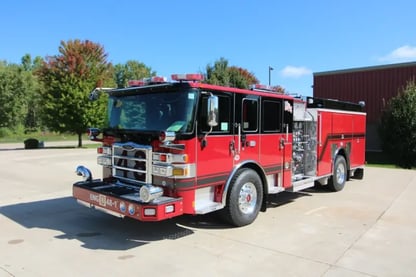 To meet these challenges head-on, HVFC recently worked with Pierce Manufacturing to add an Enforcer™ Pumper to its fleet with an Attack Pumper currently in production.
Standardizing a fleet with Pierce apparatus carries significant benefits, such as simplifying maintenance, reducing complexity when stocking parts and ensuring firefighters can move between rigs with minimal adjustment; an advantage when many crew members are volunteers.
“The [Enforcer Pumper] is going to be another tool in our toolbox. We’re excited to put this into our fleet. The two new apparatus are going to fill a very important need and be a great asset to us.” – Pat Leonard, Chief, Hershey Volunteer Fire Company, Pennsylvania
Key Features Tailored to Volunteer Operations
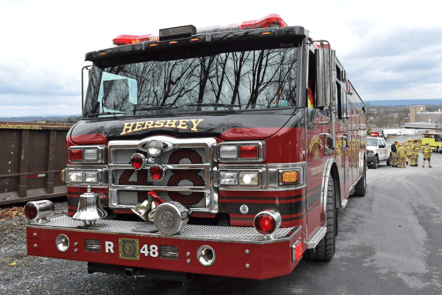 Hershey Volunteer Fire Company’s Pierce apparatus are specified with volunteer practicality at the forefront; prioritizing ease of use, versatility and consistency across the fleet. Designed to support crews who may respond with varying staffing levels and face a wide range of incident types, the features directly reflect the realities of volunteer operations. Key features include:
- Low Hosebed: A reduced height makes hose deployment safer and more manageable for volunteers of all experience levels, especially during frequent or rapid-response operations.
- Side-Mounted Ladder Placement: Ladders positioned along the body provide easier, quicker access in tight spaces; an advantage for urban, industrial or congested response areas commonly found in Hershey’s district.
- Cab Modifications for Equipment Storage: By removing unused seating, the department created space for additional mounted equipment, ensuring tools are organized, accessible and consistent across apparatus.
- Multifunctional Design: When responding to structure fires, industrial incidents, medical calls and rescues (occasionally with limited staffing), each apparatus is built to perform multiple roles without requiring a specialized unit for every scenario.
- Water Pump and Tank Capacity: Adequate onboard water and strong pumping capabilities allows crews to begin suppression immediately during industrial responses or in areas with limited hydrant access; an operational necessity for mixed urban and rural districts.
- Efficient, User-Friendly Controls: Simplified controls and modern electronic systems reduce the extensive training burden and support volunteers who may not be on apparatus daily, improving consistency and reducing the chance of errors.
Get more insights here: Volunteer Fire Department Apparatus: 5 Features to Enhance Efficiency
Consistent Layouts for Volunteer Success
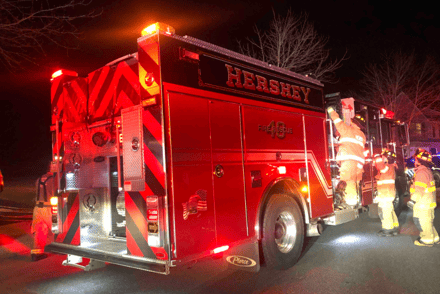 Because volunteers may switch between apparatus depending on training or call time, HVFC prioritizes layout consistency. The new pumper was designed to align closely with the department’s existing aerial platform, minimizing learning curves and speeding response.
For a volunteer department like Hershey, where members may respond on different apparatus depending on call type and who’s available, layout consistency is a necessity.
As assistant chief Colton Leonard explains, “Being a volunteer department and having different people drive apparatus at times means layout and functionality matter. We try to have apparatus laid out and carry the same equipment for ease of use and training.”
This standardization, from pumper to aerial, offers tangible benefits:
- Familiar interfaces for firefighters: Tools, controls and compartments are all in predictable places. This means even if a firefighter isn’t used to a particular rig, they can operate it confidently.
- Streamlined maintenance and parts management: With uniform rigs, stocking parts, scheduling service and training mechanics become easier, which is a real advantage when funds, time and personnel are limited.
- Faster, more coordinated responses: Volunteers don’t have to relearn apparatus on every call. Reducing cognitive load and simplifying procedures helps when seconds count.
Volunteer Culture Built to Last
While apparatus make it possible to support the needs of our community, what truly defines our department is the people and their commitment to service.
“We’ve created a strong culture by instilling community service and retaining quality people.” – Assistant Chief Colton Leonard, Hershey Volunteer Fire Company, Pennsylvania
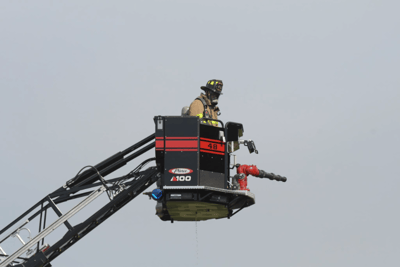 In a volunteer department which handles many call types and works around members’ lives, flexibility and community engagement are essential. From junior-firefighter programs to administrative volunteer support, Hershey Volunteer Fire Company invests in developing future generations and sustaining long-term membership.
By coupling this commitment with purpose-built, practical and consistent apparatus from Pierce, Hershey demonstrates how strategic equipment decisions can support and amplify a volunteer-driven department.
The leadership at Hershey Volunteer Fire Company prioritizes mentorship, training and purpose, creating an environment where volunteers feel valued. This is the foundation of a culture built to last.
For Hershey Volunteer Fire Company, their latest Pierce additions are more than vehicles, they’re purpose-built tools designed to meet the diverse demands of their community, while accommodating the constraints and realities of volunteer service.
Through smart specification, fleet standardization and a commitment to supporting volunteer members, HVFC is better equipped than ever to respond quickly and effectively.
If your department is considering upgrading or standardizing your fleet, the Hershey Volunteer Fire Company apparatus procurement shows just how much value custom apparatus and long-term partnerships can deliver.
Reach out to your local Pierce dealer to explore how a custom fire truck can support your department.